An example of ‘reading between the lines’

This morning I went through the news on various sites as I usually do, when I happened across a Sydney Morning Herald header that caught my attention. The headline was ‘The ABC has flab to cut’ and it was written by Louise Evans. It starts off with “Good luck trying to change anything around here, there are too many lifers.” Ms Evans continues that this was the advice given to her when she started as manager of ABC’s Radio National (RN) in April 2013. Please note that the first sentence is the only one that has any quotation marks by Ms Evans, I’m assuming that the rest is paraphrased from Ms Evan’ initial advice and will bold the text for ease of reading. The next paragraph details Ms Evans experience as a journalist, foreign correspondent, editor and managing editor at media companies that included the Australian Associated Press, Fairfax and News Corp over the last twenty years. Ms Evans goes on to make claims that after working at lean, efficient and editorially robust media companies it came as a shock for her to see the culture, waste, duplication and lax workplace practices exercised in some pockets of Radio National. And that I was even more shocked by the failure of the executive to want to do anything about it.

The person who gave Ms Evans the “lifer” advice is referred to as “one insider pointed out” and that they told her that one of the problems was a pocket of predominantly middle-aged, Anglo-Saxon staff who had never worked anywhere other than the ABC, who were impervious to change, unaccountable, untouchable and who harboured a deep sense of entitlement. Furthermore that they also, didn’t have a 9-5 mentality. They had a 10-3 mentality. They planned their work day around their afternoon yoga class. They wore thongs and shorts to work, occasionally had a snooze on the couch after lunch and popped out to Paddy’s Market to buy fresh produce for dinner before going home. They were like free-range chickens, wandering around at will, pecking at this and that, content that laying one egg constituted a hard day’s work. It also infers that the “lifers” knew that they couldn’t be sacked or officially sanctioned because the executive didn’t want to make waves, take on the union or make a case for any more redundancies.

Next is a couple of sentences on the RN budget that touches on more “shock” and the wages of 150 people being tied up in it. I’m guessing 150 is considered a large number to her because there is no other detail as to why it’s a bad thing. There was precious little budget to do anything new or innovative and you couldn’t turn any program off, no matter how high its costs and how poor its audience share and reach. Again light on detail but she clearly believes there is no innovation and that she doesn’t think that RN understands programming that turns a profit. The media industry was actually surprised by Ms Evans appointment last year, as she had plenty of experience in print journalism and commercial media but not radio and public broadcasting. Six months later there was another surprise for the industry when former ABC’s Director of Radio Kate Dundas announced “I am writing to let you know that Louise Evans has decided she does not wish to continue in the Manager role at Radio National.” “While Louise has emphasised to me how much she has enjoyed her time with RN to date, the Manager’s role has not turned out to be one she wants to continue with over time. As such we both think it’s best for Louise to step aside now.” ABC insiders at the time said that she had not found her home in the bureaucratic, resource-limited world of RN. An ABC insider also said: “There was much more upward referral in the ABC than she was used to.”

Ms Evans also complained of “archaic systems” and “blatant waste”, citing taxi dockets being left in unlocked drawers for the taking and “elephantine” leave accrual as well as them not knowing what “constitutes work.” Allegedly attempts by herself to tighten taxi use and leave, the norm in the corporate world, were frowned upon by the ABC executive and actively discouraged as “not the main game”. Programming and content generation was another “shock”, with other media organisations living and dying by their ratings, circulation and readership figures, but some ABC programmers according to Ms Evans, consider ratings irrelevant. Some producers also allegedly strongly resisted editorial oversight and locked in segments lacking relevance.

The ABC can be “leaner” and remain editorially strong and independent as ABC’s NewsRadio proves, says Ms Evans. Note the introduction of “leaner”, which is one half of American media tycoon Rupert Murdoch’s and the current federal Abbott governments favoured term at the moment – “lifters and leaners.” It gets switched to “slackers” if it involves the unemployed or Mr Murdoch’s point of view on “young adults” that aren’t rich. Ms Evans waxes on lyrically that the winds of change that have swept through media companies around the world can reinvigorate our ABC. And that’s why these ABC budget cuts announced by Communications Minister Malcolm Turnbull are not just necessary but vital to the ongoing health of the corporation. Pockets of the ABC have been allowed to get too fat, flabby, wasteful and unaccountable. And lastly that the same efficiencies and workplace practices that are the norm in corporate Australia need to be front and centre at the ABC so that it remains a strong, independent voice that is both editorially robust and reflects who we are – a culturally, geographically and socio-economically diverse nation that doesn’t believe anyone is entitled to a job for life at the taxpayer’s expense.

If we look at this article on a whole without much analysis it appears fairly unbiased however the line praising Mr Turnbull and the last line struck me as odd as they sounded familiar. A culturally, geographically and socio-economically diverse nation that doesn’t believe anyone is entitled to a job for life at the taxpayer’s expense. I noted that we had gone from critiquing RN after six months of working there which ended over one year ago to subtly commenting on job entitlements at the “taxpayers expense.” It does mention her past work history at the end of the article as – Louise Evans is a former manager at ABC’s Radio National and former managing editor at The Australian. It is deceptive however as nowhere in the article does it mention how long she was working there for and it gives the air of authority of more time than six months. The current manager Michael Mason, of RN today responded to Ms Evans piece saying that “RN undertook an efficiency review in recent years, which reviewed and reset production benchmarks and we believe it represents an outstanding return on investment. “We are very satisfied with the results and RN staff frequently tell us how we are producing a great deal more content, much more efficiently. One of our most respected presenters Dr Norman Swan recently remarked to me ‘people are unaware of just how much work is being done now with less resources’. And “the drive for efficiency at the ABC has an impact on all divisions and departments, RN included. RN generates an enormous amount of original, agenda setting influential content and staff work as hard in RN as in any part of the ABC. Lastly “we acknowledge some of the views expressed today were the result of a very unhappy period at RN for all involved.”

In conclusion, Ms Evans may have her sights set on working back there again in a position of more control, to steer it in the corporate way that she believes fit. The imagery of “lifers” and Anglo-Saxons going to yoga and wearing thongs to work, complete with the “organic chickens” comment, is only missing the oft mentioned main stream media (MSM) quote of left leaning voters as “latte sippers.” Ms Evans has worked for Mr Murdoch a lot in the past but I find the timing and apparent support for Mr Turnbull likely to be the motive behind this article. We should never accept things at face value, not now especially in the times that we live in. Why be told what to think? That is what this article is doing, “telling you” what to think, there are no links or any evidence to back up her claims just information from an alleged “insider.”


The Chinese-Australian Free Trade Agreement is a big deal and Trickle down economics isn’t

Australia and China has just recently signed a new statement of intent for it’s Free Trade Agreement (FTA), the result of four Australian Prime Minister’s and two Chinese President’s negotiations over the last ten years. The FTA’s are negotiated in secret from the public and are between multinational Corporations and the governments involved. The full details of the Australian-China FTA are yet to be released and it is to be formally signed and recognised next year. What information has been released is the apparent ‘winners’ of the FTA which are the mining sector, dairy farmers and wine exporters. The removal of tariffs on all resources and energy products, including iron ore and gold greatly benefits the mining sector, as does the removal of the 3% coking coal tariff that China was going to re-apply, and the 6% tariff on thermal coal is to be phased out within two years. The tariff attempt after nearly ten years, was seen as an effort to prop up China’s flat domestic coal sector. Basically thermal coal is for energy supply and coked coal is the integral ingredient needed for steel manufacturing. The major suppliers and exporters of thermal coal are China, Australia, South Africa, Colombia, Russia, United States and Indonesia. With the major coked coal suppliers and exporters being Australia, Canada and the United States.

Andrew Forrest is the founder of Fortescue Metals Group Ltd which is an Australian iron ore company and is the world’s fourth iron ore supplier and it provides China with around half of it’s iron ore. Gina Rinehart is Australia‘s richest person with an estimated wealth of $22 billion, and is famous for her investments in coal and iron ore along with her father Lang Hancock, ‘discovering’ iron ore as a valuable export. Mrs Rinehart will most likely benefit from the dairy sector tariff’s being phased out in four to eleven years, and the 15% infant milk powder tariff being phased out within four years. Mrs Rinehart  plans to invest $500 million to supply infant formula to China through Hope Dairies, which is controlled by Mrs Rinehart’s Hancock Prospecting. Mrs Rinehart is seeking to acquire 5,000 hectares of farmland in Queensland and to build a processing facility in South East Queensland, and aiming for the first production to be in the second half of 2016. Mrs Rinehart’s co-investor and Director Dave Garcia said “There’s another 50 million mouths probably coming online,” and that “There’s room for everyone in this right now.” This is in response to China announcing the weakening of it’s “one-child policy” late last year. With beef tariffs to also be phased out within nine years, Mr Forrest also stands to benefit from his recent investments in agriculture after recently buying Harvey Beef, Western Australia’s largest beef processor and the state’s only accredited exporter to China. His private company Minderoo Foundation has also restored a West Australian Pilbara cattle station which runs 3,000 head of cattle on a 240,000 hectare pastoral lease.

The Business Council of Australia’s first ‘Australia-Sino Hundred Year Agricultural and Food Safety Partnership’ (ASA100) meeting was in July this year with Mr Forrest as the co-chair. The meeting, which included 50 business members from each country, aims to elevate Australia as a primary and premium food and agriculture exporter to China. The members include some of Australia’s biggest agricultural ­producers and processors including Baiada Poultry, Murray Goulburn Co-operative, CBH Group, Teys Australia and Casella Wines. Last Friday Casella Wines bought Peter Lehmann Wines, to build their premium wine range and to more than likely enjoy the 14-30% wine tariff phasing over the next four years. Over the weekend a Memorandum of ­Understanding (MOU) was struck where the ASA100 agreed to “building a relationship with Infrastructure Australia” and will request that agricultural investment approvals are brought “within its remit”. The ASA100 apparently don’t want to control decision making but want to encourage investment, in particular co-investments for big ticket infrastructure such as the many processing plants required, hoping for the ­government to consider public-private partnerships or direct ones from the private sector. And so on Monday this week, Mr Forrest and Liu Yonghao Chairman, one of China’s richest men of the New Hope Group, (A multinational Chinese Corp) signed the MOU in front of Mr Abbott and Chinese President, Xi Jinping.

On Tuesday this week, the New Hope Group signed an MOU with Freedom Foods to establish an investment fund of up to $500 million to invest in dairy farms and dairy processing infrastructure. The farms will be managed by the Perich Group, which holds a stake of around 60% cent in Freedom Foods which is short for Freedom Foods Group Limited (FNP) and runs one of the nation’s biggest dairies west of Sydney, the Leppington Pastoral Company. The Perich Group, New Hope and other investors will contribute most of the equity for farm investment, which will commence in 2015. FNP is an Australia-based multinational Corporation operating in the manufacture, distribution and marketing of cereals and nutritional snacks and other food products, under the FNP brand and dairy alternative beverages that fall under the Australia’s Own brand. The Pactum Dairy Group is the long-life milk arm of FNP and last month the Abbott Government invested $1 million to support the fast tracked $18 million Shepparton upgrade plant expansion. The upgrade includes the installation of new filling and processing lines and infrastructure, enabling it to process an extra 50 million litres of long-life or Ultra Heat Treatment (UHT) milk. UHT is a process of sterilising milk that enables shelf life, of around six months and no refrigeration until you open it, perfect for warmer countries in Asia. The expansion will create 14 full-time jobs and is meant to create many more in the supply chain.

The Investor State Dispute Settlement (ISDS) mechanism is a controversial clause that allows multinational corporations to sue governments if their deemed not to be acting in their best ‘interests’. It’s in thousands of treaties, and ISDS claims have been launched against governments all over the world. The Abbott government has all but confirmed that it is included in the Chinese FTA, if true an unforgiving Chinese bureaucracy would be the least of it’s concerns if China is unhappy with something and decides to sue. Australia is still entrenched in it’s first investor-state dispute with Philip Morris Asia, due to the introduction of the ‘Tobacco Plain Packaging Act 2011’ (TPPA). The laws were introduced by the former Prime Minister Julia Gillard’s government, as a health measure but Philip Morris Asia amongst the many breaches, believes that it infringes their intellectual property. By the end of 2013, there were over 500 cases against 98 countries, for reasons such as taxes to land-zoning decisions and bans on dangerous chemicals and environmental measures taken by governments are proving to be of particular concern.

The former Gillard government also decided to ban the inclusion of ISDS in future trade agreements, they didn’t think that it harmed investment as did the Productivity Commission. The current Abbott government prefers to take it on a case by case by basis. It hasn’t agreed to it with Japan but there is a stipulation in their agreement that if an ISDS mechanism was to be included in an FTA with China then it would like one in its FTA. The Trans Pacific Partnership (TPP) is another controversial FTA proposal that twelve countries have participated in discussions with including Australia. France came out a few days ago and flatly refused to support the inclusion of the ISDS in the Trans Pacific Partnership negotiation mandate. “France did not want the ISDS to be included in the negotiation mandate,” Matthias Fekl told the French Senate. “We have to preserve the right of the state to set and apply its own standards, to maintain the impartiality of the justice system and to allow the people of France, and the world, to assert their values,” he added. Germany and Brussels have also expressed discontent at the clause.

A recent example of litigation against governments is in the United States in Vermont this year, it became the first state in the U.S. to make Genetically modified organisms (GMO) labeling mandatory, following failed attempts to pass similar laws in California and Washington. The Grocery Manufacturers Association (GMA) and three other groups, filed a lawsuit saying that the law violated free speech rights and conflicted with federal findings that GMOs are safe. The concern among many here is not only the heavy cost on tax payers but the loss of productivity and that cost borne on each country or governments economies.

In 2008 China had a contaminated milk disaster that saw children die and hundreds of thousands of children poisoned by melamine, an industrial chemical used in fertilisers and plastics, that was intentionally used to boost it’s ‘protein’ content. So understandably this coupled with the one child policy means that China does have a thirst for foreign milk, as New Zealand has successfully done since signing their FTA agreement in 2008. We could learn much from them despite their ‘growing pains’ you could say with their FTA agreement with China. The problem is that by the looks of things the spoils of using Australian resources will once again go to the elite, and it’s been proven that ‘trickle down’ economic theory that the Abbott’s government budget and policies appear to favour doesn’t work and only brings about greater inequality.

“Some people continue to defend trickle-down theories which assume that economic growth, encouraged by a free market, will inevitably succeed in bringing about greater justice and inclusiveness in the world,” Pope Francis wrote in the papal statement. “This opinion, which has never been confirmed by the facts, expresses a crude and naive trust in the goodness of those wielding economic power and in the sacra­lized workings of the prevailing economic system.” The World Economic Forum’s 2014 Global Risks Report stated, “the chronic gap between the incomes of the richest and poorest citizens is seen as the risk that is most likely to cause serious damage globally in the coming decade”.

If we look at the annual growth of employment by industry, in the mining industry it has fallen to -7.96%, economically it is not prudent for the government to keep giving it tax breaks and what not if it’s not helping with job creation. You can not achieve the economic growth that Treasurer Joe Hockey espouses, especially with the likes of global multinational tax evasion hitting bottom lines. You also can not by letting the big four banks, the big two supermarkets etc have such a monopoly on the market and not use their profits to promote genuine job creation that actually benefits the economy, let alone the stifle hold on genuine ‘competition’. Greater corporate responsibility is needed and can only be implemented by the government, big business is not elected to run our country or control our purse strings. A cost benefit analysis made available to the public with guarantees in place that the tax payers money won’t be used if a multinational decides to sue us on a whim is surely reasonable? The government needs to engage in genuine bipartisan discussion at the very most in regards to ISDS to cover ourselves before we sign on that dotted line with China or any other country. The rest needs realistic and thoughtful discussion as to find solutions.

Global tax evasion, inequality and quantitative easing…

The Group of twenty (G20) committed to finding a global solution for tax evasion after the financial crisis, and in 2009 it agreed to make arrangements for the exchanging of tax information between tax administrations around the world. In October this year the Organisation for Economic Co-operation and Development (OECD) and the G20 officially endorsed the automatic exchange of tax information between all OECD and G20 countries as well as major financial centres that participate in the annual meeting of the Global Forum on Transparency and Exchange of Information for Tax Purposes in Berlin. A status report on committed and not committed countries or jurisdictions and whether they will start reporting information in 2017 or 2018, is to be presented to G20 leaders during the annual summit held in Brisbane in less than two weeks. Australia along with thirty-eight other countries that include China, Saudi Arabia and Hong Kong have chosen to start the reporting of information in 2018. There has been much conjecture in the media and amongst politicians in the Australian Labor Party (ALP) as to why the G20 host country isn’t setting a good example by being one of the first to report in time for the G20 in 2017. Global tax avoidance has been a big priority for Prime Minister Tony Abbott’s government, and it dragging it’s heels for reporting tax evasion has been viewed as at odds with it’s agenda. It’s also to be noted that in mid-October this year The European Union (EU) finance ministers also agreed to a far-reaching crackdown on tax evasion and to make sure that their standards were on par with the global rules by 2017.

As I briefly wrote in my last article multinational corporation owner Rupert Murdoch, was invited last month by Treasurer Joe Hockey to address the G20 in Washington, for the International Money Fund’s (IMF) annual meeting. It was the first time that a non-political leader had addressed the group of world leaders. Mr Murdoch surprised many in his nine page speech, by addressing the problem of global inequality. He used percentages of the tax paid by the richest 1% of nations to highlight this but a better analogy is that eighty-five people in the world equal the wealth of 3.5bn people worldwide. He also referenced his Brisbane 20 (B20) speech, reiterating his belief that governments should “stay out of the way”, and let businessmen run things. Mr Murdoch concedes that the verdict is still out on the money experiment of quantitative easing (QE), “but that we already know that one result has been greater inequality”. He also said: “Quantitative Easing has increased the price of assets, such as stocks and real estate and that has helped first and foremost those who already have assets.” 

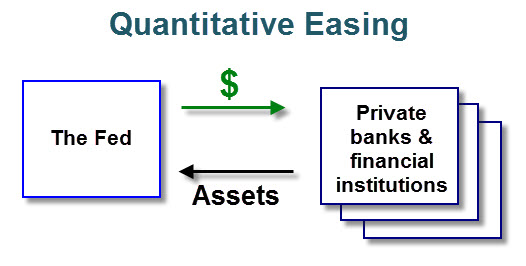
To provide a brief overview of QE, (please refer to the featured image at the top of the page), it’s basically a monetary policy for stimulating the economy that was adopted by the US, Japan, the UK and Europe after the financial crisis of 2008. Using the US Federal Reserve bank (Fed) as an example, it buys “assets” from commercial banks and other private financial institutions or rather various forms of “debt”. The main forms of debt purchased are treasury bills, notes, bonds and mortgage backed security papers, which appear as “assets” on the governments balance sheets once purchased. QE differs from normal monetary policy, in that when the Fed normally purchases various bonds it usually lowers interest rates while also increasing the amount of money in the system. QE can’t lower interbank interest rates because they’re already at 0%, only the quantity of money is controlled because the price can’t be. As Mr Murdoch has said the verdict is out as to the success of the QE monetary policy, but let’s think of it this way; it was originally billed as a $600bn exercise but ended up being $3,700bn and the Fed’s balance sheet has also grown more than three-times in just over five years and is an unprecedented monetary expansion. Some of QE’s unintended consequences are reported to include, money sitting on balance sheets of busted banks pretending to be solvent, and money finding its way into asset markets and tangible “assets” as Mr Murdoch referenced in his speech. Tax evasion and the residual effects on the countries it does it’s business in while effectively paying nothing, coupled with countries such as Ireland, offering extremely low corporate tax rates is more than likely a larger part of the explanation than dubious monetary policy. QE finished in the US last month, time will tell how it went.

The “double Irish” is a well known tax loophole that allows corporations to register in Ireland and to also be a tax resident in another country, usually ones that don’t even have corporate income taxes, such as Bermuda. US corporations for example, are making huge profits in other tax havens such as the Cayman Islands and the British Virgin Islands. Some of the profits exceed the gross domestic product or the GDP of the host country, with Bermuda’s offshore profits being an incredible 1643% of their total economic output. Put simply, US companies reported $94bn in profit while the Bermuda’s GDP was just $6 billion, according to data collected and a report by the US International Revenue Service and from subsidiaries reporting profits outside of the US in 2010.

During the Irish Budget 2015 announcements, the Minister for Finance Michael Noonan confirmed that the “double Irish” tax deal would finish as of January 2015 after pressure from the EU. However all companies currently operating within the tax deal have until December 31, 2020 to adjust their financial practices accordingly. While this a step in the right direction, is this not also tempting corporations to find further loopholes within that time frame? Mr Noonan said further: “Aggressive tax planning by the multinational companies has been criticized by governments across the globe and has damaged the reputation of many countries.” Following the announcement, some companies registered in Ireland pledged to work within the new regulations. And Google said: “As we’ve always said, it’s for governments to decide the law and for companies to comply with it . . . We’re deeply committed to Ireland and will work to implement these changes as they become law.”

Having cracked down on the “double Irish”, Mr Noonan also strongly said that Ireland wouldn’t be changing its corporate tax rate, which is 12.5% and is the eighth lowest in the EU with the US being 35%. “The 12.5% tax rate remains at the heart of this,” Mr Noonan also said: “The government has successfully protected the 12.5% tax rate in recent years. The 12.5% tax rate never has been and never will be up for discussion. [It is] settled policy. It will not change.”

Australia’s top companies have been nonplussed according to local media, despite the global crackdown on corporate tax avoidance with almost 60% of our top 200 listed companies still holding subsidiaries in tax havens or low-tax jurisdictions. Data has also shown that some companies that promised to get out of tax havens have actually added to their offshore subsidiaries. And companies such as 21st Century Fox, Westfield, Toll Holdings and Telstra, have more than 40 entities in these well-known tax havens. Fourteen of the 20 top companies, including two of Australian’s biggest banks, also hold entities in these locations. The report also reveals nearly a third of the previously mentioned 200 companies are now paying less than 10% tax on profit compared to the statutory corporate tax rate of 30 per cent in Australia, (to be adjusted to 28.5% in 2015). “Secrecy jurisdictions play a key role in multinational tax dodging and undermine the ability of democratically elected governments to levy taxes in a just and fair way,” the report also says that: “Corporate tax avoidance must be addressed.”

Mr Murdoch also spoke of wanting less bank regulation and that his policy priorities are education, immigration reform, infrastructure investment, and cheap energy. The cheap energy is a reference to American natural gas not cheap Australian energy. He also thinks that the EU overly regulates and doesn’t like the EU because of their anti-competition laws, regarding his UK media ownership strangle hold and because he would like to have a crack at the European market. The UK has recently being making noise to leave the EU with UK Prime Minister David Cameron, recently failing to get an EU membership referendum through, he isn’t giving up though. Mr Cameron has a fight on his hands with the United Kingdom Independent Party (UKIP) which was once a fringe anti-EU group that has grown considerably and the leader Nigel Farage having Mr Murdoch’s seal of approval.

Mr Murdoch clearly has our government’s ear in particular Mr Hockey’s, as he espouses everything that I have mentioned from his speech including his favoured policies, but the difference is he sells it as the Abbott government’s policies. This isn’t democracy and obviously Australian’s did not vote for him and most probably don’t even know who he is. How much longer will our politicians pander to a man that renounced his own Australian citizenship to become a naturalised American to buy more TV licences in America? A man that controls most of the UK, American and Australian media, because Mr Murdoch is definitely not ‘Team Australia’, only when and if it suits his bank balance.