
Rare earth elements (REE), have become a hot topic of discussion ever since Trump 2.0 began. Even more so since China put export limits on their REE, rare earth magnets, and semiconductor materials that contain 0.1% of REE. China first discovered REE in inner Mongolia in 1927, they have invested heavily into the research and development of rare earth technologies since then. This is why they can successfully do large scale processing today.
An American policy turned back on them
The export mechanism that China is using, is actually an American policy called the foreign direct product rule (FDPR). America has used the FDPR as a tool to restrict the sale of Huawei products in the west, and has used it to restrict semiconductor exports to China for years. America also uses it to control other transactions between other countries and China.
China’s international obligations
When China made their REE announcement, they explained that they have already had export controls for over 20-years. The increase of controls is to combat REE being used to make dangerous weaponry and to prevent dual use. Dual use is when REE is used for civilian and military use. This is not just about their national security and interests, it’s also about fulfilling their international obligations with the Treaty of Non-proliferation of Nuclear Weapons. There are still four countries that haven’t signed the treaty: India, Israel, Pakistan and South Sudan. Responsible oversight of the REE global supply chain is needed more than ever in these times.
Any company affiliated with foreign militaries will be denied export licenses. China’s Ministry of Commerce said emphatically, that any requests to use their REE for military reasons will be rejected. This is a major setback for America’s weapon production capabilities, especially at a time when their stockpiles are low. It’s also bad news for the AI industry with the restrictions on semiconductors.
REE used for Warmongering
Last year NATO published a list of critical raw materials for defence.
- Aluminium
- Beryllium
- Cobalt
- Gallium
- Germanium
- Graphite
- Lithium
- Manganese
- Platinum
- Rare Earth Elements
- Titanium
- Tungsten
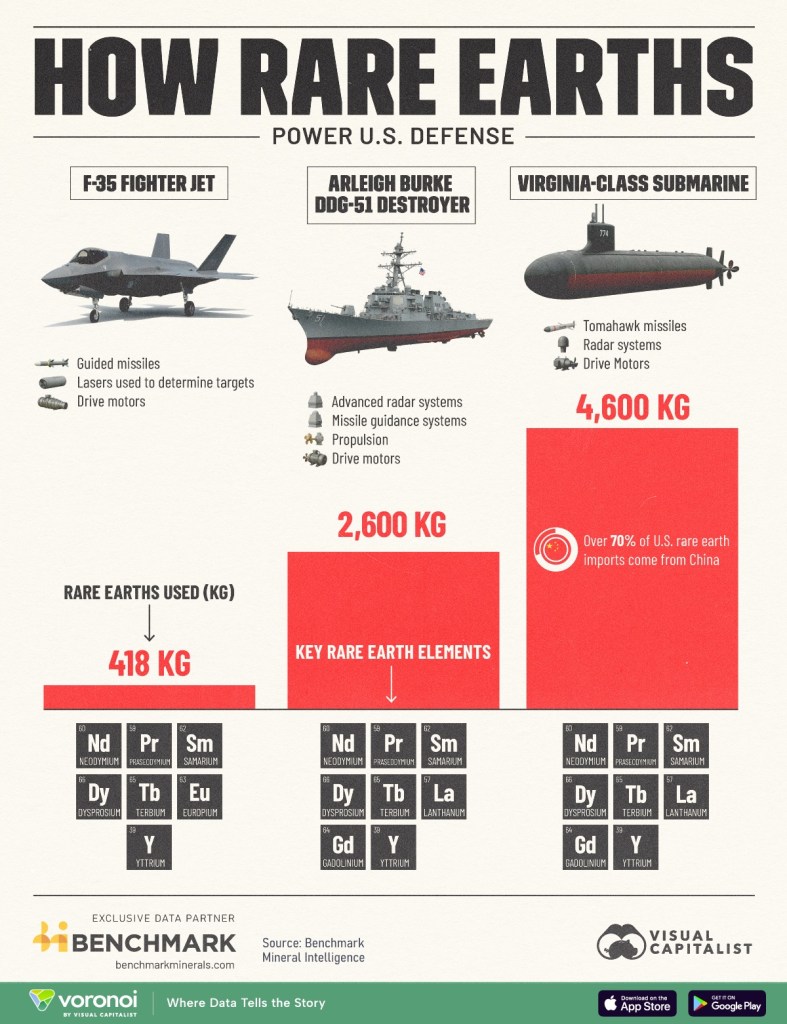
REE is essential for the production of military technologies such as: F35 Fighter Jets, Virginia and Columbia Class Submarines, Tomahawk Missiles, Radar Systems, Predator Unmanned Aerial Vehicles, and the Joint Direct Attack Munition Series of Smart Bombs.
Australia’s role in helping America
The recent “critical mineral agreement” signed by Australia and America is not just about the supply of REE, it’s also about Australia developing a Bauxite-to-Gallium refining pipeline. The Pentagon is going to be funding the construction of the Gallium refinery in West Australia.
Gallium can only be produced as a byproduct of Bauxite mining and Australia has the second largest reserves of Bauxite, which is the main ore of Aluminium, Gallium is a byproduct of Aluminium. Australia has eight of the REE that NATO listed above as crucial for defence included in the recently signed agreement.
Australian Ambassador to America, Kevin Rudd, emphasised in an interview earlier this year with the Centre for Strategic and International Studies, that critical minerals are defence assets. He also said: “Geology has been kind to us. It’s an ancient continent, it’s been worn flat, the stuff’s closer to the surface.”
First Nations People left out of the picture
Kevin Rudd is right, Australia is an ancient continent, so shouldn’t First Nations people should be part of the REE discussion? The Mirrar people fought uranium mining on their land for decades, they won their fight just last year. Traditional land owners take responsibility not just for the land, they also care about what the impacts of activities such as mining their land, has on others.
In 2011 Yvonne Margarula, of the Mirrar people, wrote a letter to UN Secretary General Ban-ki Moon, expressing her sorrow at the impacts radiation was having on the lives of Japanese people. She noted that: ‘it is likely that the radiation problems at Fukushima are, at least in part, fuelled by uranium derived from our traditional lands. This makes us feel very sad.’
Can China even be overtaken
Arnaud Bertrand, wrote an excellent article that is worth reading, the Substack link is at the end of this article. He forensically outlines the impossibility of other countries being able to catch up with China. It’s not just about building refining infrastructure to match China, there’s the specialised skills of workers to consider and intensive energy requirements. As well as the fact that a whole ecosystem and logistics network needs to be built. Something that China has built for decades. There is also the question of purity, for REE to be viable for use, it needs to be at least 99.9%.
The dangers of extraction and radioactive waste
Australia is a large aluminium producer which is why it has been chosen by America to refine Aluminium for its byproduct, Gallium. Smelting aluminium in itself is bad enough for the environment. To even get to the extraction point of Gallium you need to process Alumina, then you need to refine the Aluminium before you can extract the REE.
All of these processes lead to a form of radiation called TENORM, (Technologically Enhanced Naturally Occurring Radioactive Materials).
“Naturally occurring radioactive materials that have been concentrated or exposed to the accessible environment as a result of human activities such as manufacturing, mineral extraction, or water processing.”
What to do with all of the excess Aluminium
As Arnaud explained, to produce 100 tonnes of Gallium per year, you would need to produce 12 million tonnes of Alumina and 4.7 million tonnes of Aluminium. You only need a small amount of REE to produce things, but it is an extremely intensive, extraction process. There is also the oversupply factor, there has been a global supply glut of Aluminium for years.
It’s not just about oil in Venezuela
It’s of note that Venezuela has not just a lot of oil, it also has a Bauxite mine and is a major producer and exporter of Bauxite. Greenland has lots of REE too, but they’re extremely difficult to get to and they don’t have mines for them.
Give peace a chance
Providing REE to America for nuclear weapons to potentially use against China, is an existential threat to its existence. It’s important to know that China’s export controls aren’t aimed at hurting America economically. You just have to apply for a license letting them know what you are using REE for. If it’s for bombs etc they don’t want their products to be used for making them. If it’s for humanitarian reasons, no problem.
What happens next remains to be seen, but it’s nice to have some breathing room while America works out its next move.
Sources
https://youtu.be/eX3WlHcTvF8?si=PdifC39kw02oVqiW
https://www.nato.int/cps/en/natohq/news_231765.htm
https://www.csis.org/analysis/unpacking-us-australia-critical-minerals-framework-agreement
https://elements.visualcapitalist.com/visualizing-how-rare-earths-power-u-s-defense/
https://www.theguardian.com/environment/2010/dec/26/rare-earth-metals-us
https://www.dw.com/en/australia-uranium-mining-to-be-banned-at-indigenous-site/a-69785799
https://static1.1.sqspcdn.com/static/f/356082/11963020/1303983838710/Yvonne+Margarula+Fukushima+Lett

 MelMac Politics