The Chinese-Australian Free Trade Agreement is a big deal and Trickle down economics isn’t

Australia and China has just recently signed a new statement of intent for it’s Free Trade Agreement (FTA), the result of four Australian Prime Minister’s and two Chinese President’s negotiations over the last ten years. The FTA’s are negotiated in secret from the public and are between multinational Corporations and the governments involved. The full details of the Australian-China FTA are yet to be released and it is to be formally signed and recognised next year. What information has been released is the apparent ‘winners’ of the FTA which are the mining sector, dairy farmers and wine exporters. The removal of tariffs on all resources and energy products, including iron ore and gold greatly benefits the mining sector, as does the removal of the 3% coking coal tariff that China was going to re-apply, and the 6% tariff on thermal coal is to be phased out within two years. The tariff attempt after nearly ten years, was seen as an effort to prop up China’s flat domestic coal sector. Basically thermal coal is for energy supply and coked coal is the integral ingredient needed for steel manufacturing. The major suppliers and exporters of thermal coal are China, Australia, South Africa, Colombia, Russia, United States and Indonesia. With the major coked coal suppliers and exporters being Australia, Canada and the United States.

Andrew Forrest is the founder of Fortescue Metals Group Ltd which is an Australian iron ore company and is the world’s fourth iron ore supplier and it provides China with around half of it’s iron ore. Gina Rinehart is Australia‘s richest person with an estimated wealth of $22 billion, and is famous for her investments in coal and iron ore along with her father Lang Hancock, ‘discovering’ iron ore as a valuable export. Mrs Rinehart will most likely benefit from the dairy sector tariff’s being phased out in four to eleven years, and the 15% infant milk powder tariff being phased out within four years. Mrs Rinehart  plans to invest $500 million to supply infant formula to China through Hope Dairies, which is controlled by Mrs Rinehart’s Hancock Prospecting. Mrs Rinehart is seeking to acquire 5,000 hectares of farmland in Queensland and to build a processing facility in South East Queensland, and aiming for the first production to be in the second half of 2016. Mrs Rinehart’s co-investor and Director Dave Garcia said “There’s another 50 million mouths probably coming online,” and that “There’s room for everyone in this right now.” This is in response to China announcing the weakening of it’s “one-child policy” late last year. With beef tariffs to also be phased out within nine years, Mr Forrest also stands to benefit from his recent investments in agriculture after recently buying Harvey Beef, Western Australia’s largest beef processor and the state’s only accredited exporter to China. His private company Minderoo Foundation has also restored a West Australian Pilbara cattle station which runs 3,000 head of cattle on a 240,000 hectare pastoral lease.

The Business Council of Australia’s first ‘Australia-Sino Hundred Year Agricultural and Food Safety Partnership’ (ASA100) meeting was in July this year with Mr Forrest as the co-chair. The meeting, which included 50 business members from each country, aims to elevate Australia as a primary and premium food and agriculture exporter to China. The members include some of Australia’s biggest agricultural ­producers and processors including Baiada Poultry, Murray Goulburn Co-operative, CBH Group, Teys Australia and Casella Wines. Last Friday Casella Wines bought Peter Lehmann Wines, to build their premium wine range and to more than likely enjoy the 14-30% wine tariff phasing over the next four years. Over the weekend a Memorandum of ­Understanding (MOU) was struck where the ASA100 agreed to “building a relationship with Infrastructure Australia” and will request that agricultural investment approvals are brought “within its remit”. The ASA100 apparently don’t want to control decision making but want to encourage investment, in particular co-investments for big ticket infrastructure such as the many processing plants required, hoping for the ­government to consider public-private partnerships or direct ones from the private sector. And so on Monday this week, Mr Forrest and Liu Yonghao Chairman, one of China’s richest men of the New Hope Group, (A multinational Chinese Corp) signed the MOU in front of Mr Abbott and Chinese President, Xi Jinping.

On Tuesday this week, the New Hope Group signed an MOU with Freedom Foods to establish an investment fund of up to $500 million to invest in dairy farms and dairy processing infrastructure. The farms will be managed by the Perich Group, which holds a stake of around 60% cent in Freedom Foods which is short for Freedom Foods Group Limited (FNP) and runs one of the nation’s biggest dairies west of Sydney, the Leppington Pastoral Company. The Perich Group, New Hope and other investors will contribute most of the equity for farm investment, which will commence in 2015. FNP is an Australia-based multinational Corporation operating in the manufacture, distribution and marketing of cereals and nutritional snacks and other food products, under the FNP brand and dairy alternative beverages that fall under the Australia’s Own brand. The Pactum Dairy Group is the long-life milk arm of FNP and last month the Abbott Government invested $1 million to support the fast tracked $18 million Shepparton upgrade plant expansion. The upgrade includes the installation of new filling and processing lines and infrastructure, enabling it to process an extra 50 million litres of long-life or Ultra Heat Treatment (UHT) milk. UHT is a process of sterilising milk that enables shelf life, of around six months and no refrigeration until you open it, perfect for warmer countries in Asia. The expansion will create 14 full-time jobs and is meant to create many more in the supply chain.

The Investor State Dispute Settlement (ISDS) mechanism is a controversial clause that allows multinational corporations to sue governments if their deemed not to be acting in their best ‘interests’. It’s in thousands of treaties, and ISDS claims have been launched against governments all over the world. The Abbott government has all but confirmed that it is included in the Chinese FTA, if true an unforgiving Chinese bureaucracy would be the least of it’s concerns if China is unhappy with something and decides to sue. Australia is still entrenched in it’s first investor-state dispute with Philip Morris Asia, due to the introduction of the ‘Tobacco Plain Packaging Act 2011’ (TPPA). The laws were introduced by the former Prime Minister Julia Gillard’s government, as a health measure but Philip Morris Asia amongst the many breaches, believes that it infringes their intellectual property. By the end of 2013, there were over 500 cases against 98 countries, for reasons such as taxes to land-zoning decisions and bans on dangerous chemicals and environmental measures taken by governments are proving to be of particular concern.

The former Gillard government also decided to ban the inclusion of ISDS in future trade agreements, they didn’t think that it harmed investment as did the Productivity Commission. The current Abbott government prefers to take it on a case by case by basis. It hasn’t agreed to it with Japan but there is a stipulation in their agreement that if an ISDS mechanism was to be included in an FTA with China then it would like one in its FTA. The Trans Pacific Partnership (TPP) is another controversial FTA proposal that twelve countries have participated in discussions with including Australia. France came out a few days ago and flatly refused to support the inclusion of the ISDS in the Trans Pacific Partnership negotiation mandate. “France did not want the ISDS to be included in the negotiation mandate,” Matthias Fekl told the French Senate. “We have to preserve the right of the state to set and apply its own standards, to maintain the impartiality of the justice system and to allow the people of France, and the world, to assert their values,” he added. Germany and Brussels have also expressed discontent at the clause.

A recent example of litigation against governments is in the United States in Vermont this year, it became the first state in the U.S. to make Genetically modified organisms (GMO) labeling mandatory, following failed attempts to pass similar laws in California and Washington. The Grocery Manufacturers Association (GMA) and three other groups, filed a lawsuit saying that the law violated free speech rights and conflicted with federal findings that GMOs are safe. The concern among many here is not only the heavy cost on tax payers but the loss of productivity and that cost borne on each country or governments economies.

In 2008 China had a contaminated milk disaster that saw children die and hundreds of thousands of children poisoned by melamine, an industrial chemical used in fertilisers and plastics, that was intentionally used to boost it’s ‘protein’ content. So understandably this coupled with the one child policy means that China does have a thirst for foreign milk, as New Zealand has successfully done since signing their FTA agreement in 2008. We could learn much from them despite their ‘growing pains’ you could say with their FTA agreement with China. The problem is that by the looks of things the spoils of using Australian resources will once again go to the elite, and it’s been proven that ‘trickle down’ economic theory that the Abbott’s government budget and policies appear to favour doesn’t work and only brings about greater inequality.

“Some people continue to defend trickle-down theories which assume that economic growth, encouraged by a free market, will inevitably succeed in bringing about greater justice and inclusiveness in the world,” Pope Francis wrote in the papal statement. “This opinion, which has never been confirmed by the facts, expresses a crude and naive trust in the goodness of those wielding economic power and in the sacra­lized workings of the prevailing economic system.” The World Economic Forum’s 2014 Global Risks Report stated, “the chronic gap between the incomes of the richest and poorest citizens is seen as the risk that is most likely to cause serious damage globally in the coming decade”.

If we look at the annual growth of employment by industry, in the mining industry it has fallen to -7.96%, economically it is not prudent for the government to keep giving it tax breaks and what not if it’s not helping with job creation. You can not achieve the economic growth that Treasurer Joe Hockey espouses, especially with the likes of global multinational tax evasion hitting bottom lines. You also can not by letting the big four banks, the big two supermarkets etc have such a monopoly on the market and not use their profits to promote genuine job creation that actually benefits the economy, let alone the stifle hold on genuine ‘competition’. Greater corporate responsibility is needed and can only be implemented by the government, big business is not elected to run our country or control our purse strings. A cost benefit analysis made available to the public with guarantees in place that the tax payers money won’t be used if a multinational decides to sue us on a whim is surely reasonable? The government needs to engage in genuine bipartisan discussion at the very most in regards to ISDS to cover ourselves before we sign on that dotted line with China or any other country. The rest needs realistic and thoughtful discussion as to find solutions.

Global tax evasion, inequality and quantitative easing…

The Group of twenty (G20) committed to finding a global solution for tax evasion after the financial crisis, and in 2009 it agreed to make arrangements for the exchanging of tax information between tax administrations around the world. In October this year the Organisation for Economic Co-operation and Development (OECD) and the G20 officially endorsed the automatic exchange of tax information between all OECD and G20 countries as well as major financial centres that participate in the annual meeting of the Global Forum on Transparency and Exchange of Information for Tax Purposes in Berlin. A status report on committed and not committed countries or jurisdictions and whether they will start reporting information in 2017 or 2018, is to be presented to G20 leaders during the annual summit held in Brisbane in less than two weeks. Australia along with thirty-eight other countries that include China, Saudi Arabia and Hong Kong have chosen to start the reporting of information in 2018. There has been much conjecture in the media and amongst politicians in the Australian Labor Party (ALP) as to why the G20 host country isn’t setting a good example by being one of the first to report in time for the G20 in 2017. Global tax avoidance has been a big priority for Prime Minister Tony Abbott’s government, and it dragging it’s heels for reporting tax evasion has been viewed as at odds with it’s agenda. It’s also to be noted that in mid-October this year The European Union (EU) finance ministers also agreed to a far-reaching crackdown on tax evasion and to make sure that their standards were on par with the global rules by 2017.

As I briefly wrote in my last article multinational corporation owner Rupert Murdoch, was invited last month by Treasurer Joe Hockey to address the G20 in Washington, for the International Money Fund’s (IMF) annual meeting. It was the first time that a non-political leader had addressed the group of world leaders. Mr Murdoch surprised many in his nine page speech, by addressing the problem of global inequality. He used percentages of the tax paid by the richest 1% of nations to highlight this but a better analogy is that eighty-five people in the world equal the wealth of 3.5bn people worldwide. He also referenced his Brisbane 20 (B20) speech, reiterating his belief that governments should “stay out of the way”, and let businessmen run things. Mr Murdoch concedes that the verdict is still out on the money experiment of quantitative easing (QE), “but that we already know that one result has been greater inequality”. He also said: “Quantitative Easing has increased the price of assets, such as stocks and real estate and that has helped first and foremost those who already have assets.” 

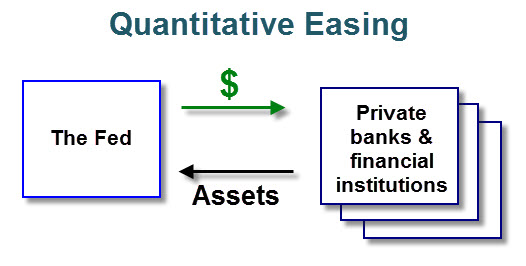
To provide a brief overview of QE, (please refer to the featured image at the top of the page), it’s basically a monetary policy for stimulating the economy that was adopted by the US, Japan, the UK and Europe after the financial crisis of 2008. Using the US Federal Reserve bank (Fed) as an example, it buys “assets” from commercial banks and other private financial institutions or rather various forms of “debt”. The main forms of debt purchased are treasury bills, notes, bonds and mortgage backed security papers, which appear as “assets” on the governments balance sheets once purchased. QE differs from normal monetary policy, in that when the Fed normally purchases various bonds it usually lowers interest rates while also increasing the amount of money in the system. QE can’t lower interbank interest rates because they’re already at 0%, only the quantity of money is controlled because the price can’t be. As Mr Murdoch has said the verdict is out as to the success of the QE monetary policy, but let’s think of it this way; it was originally billed as a $600bn exercise but ended up being $3,700bn and the Fed’s balance sheet has also grown more than three-times in just over five years and is an unprecedented monetary expansion. Some of QE’s unintended consequences are reported to include, money sitting on balance sheets of busted banks pretending to be solvent, and money finding its way into asset markets and tangible “assets” as Mr Murdoch referenced in his speech. Tax evasion and the residual effects on the countries it does it’s business in while effectively paying nothing, coupled with countries such as Ireland, offering extremely low corporate tax rates is more than likely a larger part of the explanation than dubious monetary policy. QE finished in the US last month, time will tell how it went.

The “double Irish” is a well known tax loophole that allows corporations to register in Ireland and to also be a tax resident in another country, usually ones that don’t even have corporate income taxes, such as Bermuda. US corporations for example, are making huge profits in other tax havens such as the Cayman Islands and the British Virgin Islands. Some of the profits exceed the gross domestic product or the GDP of the host country, with Bermuda’s offshore profits being an incredible 1643% of their total economic output. Put simply, US companies reported $94bn in profit while the Bermuda’s GDP was just $6 billion, according to data collected and a report by the US International Revenue Service and from subsidiaries reporting profits outside of the US in 2010.

During the Irish Budget 2015 announcements, the Minister for Finance Michael Noonan confirmed that the “double Irish” tax deal would finish as of January 2015 after pressure from the EU. However all companies currently operating within the tax deal have until December 31, 2020 to adjust their financial practices accordingly. While this a step in the right direction, is this not also tempting corporations to find further loopholes within that time frame? Mr Noonan said further: “Aggressive tax planning by the multinational companies has been criticized by governments across the globe and has damaged the reputation of many countries.” Following the announcement, some companies registered in Ireland pledged to work within the new regulations. And Google said: “As we’ve always said, it’s for governments to decide the law and for companies to comply with it . . . We’re deeply committed to Ireland and will work to implement these changes as they become law.”

Having cracked down on the “double Irish”, Mr Noonan also strongly said that Ireland wouldn’t be changing its corporate tax rate, which is 12.5% and is the eighth lowest in the EU with the US being 35%. “The 12.5% tax rate remains at the heart of this,” Mr Noonan also said: “The government has successfully protected the 12.5% tax rate in recent years. The 12.5% tax rate never has been and never will be up for discussion. [It is] settled policy. It will not change.”

Australia’s top companies have been nonplussed according to local media, despite the global crackdown on corporate tax avoidance with almost 60% of our top 200 listed companies still holding subsidiaries in tax havens or low-tax jurisdictions. Data has also shown that some companies that promised to get out of tax havens have actually added to their offshore subsidiaries. And companies such as 21st Century Fox, Westfield, Toll Holdings and Telstra, have more than 40 entities in these well-known tax havens. Fourteen of the 20 top companies, including two of Australian’s biggest banks, also hold entities in these locations. The report also reveals nearly a third of the previously mentioned 200 companies are now paying less than 10% tax on profit compared to the statutory corporate tax rate of 30 per cent in Australia, (to be adjusted to 28.5% in 2015). “Secrecy jurisdictions play a key role in multinational tax dodging and undermine the ability of democratically elected governments to levy taxes in a just and fair way,” the report also says that: “Corporate tax avoidance must be addressed.”

Mr Murdoch also spoke of wanting less bank regulation and that his policy priorities are education, immigration reform, infrastructure investment, and cheap energy. The cheap energy is a reference to American natural gas not cheap Australian energy. He also thinks that the EU overly regulates and doesn’t like the EU because of their anti-competition laws, regarding his UK media ownership strangle hold and because he would like to have a crack at the European market. The UK has recently being making noise to leave the EU with UK Prime Minister David Cameron, recently failing to get an EU membership referendum through, he isn’t giving up though. Mr Cameron has a fight on his hands with the United Kingdom Independent Party (UKIP) which was once a fringe anti-EU group that has grown considerably and the leader Nigel Farage having Mr Murdoch’s seal of approval.

Mr Murdoch clearly has our government’s ear in particular Mr Hockey’s, as he espouses everything that I have mentioned from his speech including his favoured policies, but the difference is he sells it as the Abbott government’s policies. This isn’t democracy and obviously Australian’s did not vote for him and most probably don’t even know who he is. How much longer will our politicians pander to a man that renounced his own Australian citizenship to become a naturalised American to buy more TV licences in America? A man that controls most of the UK, American and Australian media, because Mr Murdoch is definitely not ‘Team Australia’, only when and if it suits his bank balance.

The latest GST push and reading between the lines

Last weekend Australian Prime Minister, Tony Abbott put the goods and services tax (GST) back on the table. Last night Mr Abbott gave a speech to the Business Council of Australia (BCA), challenging big business to lead the “fight” for tax reform and to help convince the Labor party (ALP) “to join team Australia and think of our country and not the next election.” Despite Mr Abbott saying pre-election that “the GST will not change, full stop, end of story” on Monday he confirmed that changes to the GST would “all be looked at as part of the federation reform process and as part of the tax reform process”.

The current government is clearly pro big business, with Mr Abbott taking big business leaders on his first overseas trip to Indonesia last year and other trips to China, America (USA) and Canada declaring that “Australia is open for business.” Business magnate Rupert Murdoch was invited this month by Australian Treasurer, Joe Hockey to address the Group of twenty (G20) dinner, for finance ministers in Washington for the International Money Fund’s (IMF) annual meeting.The first time that someone from outside the G20 has addressed the group.

And speaking of big business influence let’s not forget the enormous influence on the government wielded by the Institute of Public Affairs (IPA). It’s founders being a group of business leaders that included Mr Murdoch’s father, Sir Keith Murdoch. And according to their website: The IPA was formed in 1943 to provide a firm philosophical grounding for free market policy and ideas because it believed the then Labor government wanted to exploit wartime circumstances to massively increase the role of the Commonwealth government, taking powers from state governments, and undermining the freedom of citizens. Rupert Murdoch served on the IPA Council in the years 1986 through to 2000 and he gave the key note address for the IPA’s 70th anniversary last year.

The IPA also last year came up with a seventy-five point list of ideas for the government and buoyed by positive government feedback it came back with a further twenty-five ideas. Amongst the second lot of ideas was their GST and health policies: 78. Extend the GST to cover all goods and services but return all extra revenue to taxpayers through cutting other taxes. And 79. Abolish the federal department of health and return health policy to the states. 

The BCA released their paper ‘The Future of Tax Australia’s Current Tax System’ in September this year, and this sentence is of particular interest: Vertical fiscal imbalance will be exacerbated over time as demand for health services increase while the tax base of states and territories is further eroded, for example due to the GST-exempt status of items such as health expenditure.

If we look at the health services that are GST free (without considering medical services or medical aids), they include many things such as dental, nursing, psychology, pharmacy, optometry and social work. Considering the governments attempt at a medical levy in their as yet to be passed budget, and the wish for the states to run their own states, could this be their work around? We witnessed yesterday just how hard nosed this government can be with the introduction of the fuel excise despite it not passing Parliament and side stepping the Senate.

Apart from the fact that it’s lazy, the Australian people voted for the government to run our country not big business, the BCA, the IPA, Mr Murdoch or lobby groups. And the fact that Mr Abbott is asking for help from big business in persuading the ALP to “join Team Australia” is unsettling because it doesn’t resemble democracy in the slightest. If the broadening of the GST or increasing of it is remotely on the cards it needs to be brought to the people as well as big and “small” business. The budget situation needs mature discussion within the government itself to find solutions, not finding it’s saving measures through underhanded tactics.

Is the latest war really about terrorism or American ‘issues’?

BRIC is the acronym for the four country alliance, Brazil, Russia, India and China economic group. BRIC had their first major summit in Russia in June 2009, calling for a more diversified International monetary system and wanting a bigger say in the global financial system. “The emerging and developing economies must have a greater voice and representation in international financial institutions.” “The summit must create the conditions for a fairer world order,” the BRIC leaders said in their final statement of the first summit. In December 2010 South Africa got invited by China and it is now commonly known as BRICS. The term BRICS came about from former Goldman Sachs economist Jim O’Neill, in his publication Building Better Global Economic BRICs.

As of 2014, the five BRICS countries represent nearly 3 billion people or 40 percent of the world population, they have about US$4 trillion in combined foreign reserves and their global economic output is around 18 percent. In 2003 Goldman Sachs forecast that China and India would become the first and third largest economies by 2050, with Brazil and Russia taking the fifth and sixth spots.

In 2010 at the Group of twenty (G20) summit in Canada, the global financial system discussion turned to the International Money Fund’s (IMF) and reforms of the fund’s quotas and governance. The IMF was created in 1945 by 29 member countries at the end of World War ll, to rebuild the global economic system and provide money and resources in times of crisis. Countries contribute funds to the IMF through a quota system with the current quota formula being a weighted average of gross domestic product (GDP); weight at 50 percent, openness at 30 percent, economic variability at 15 percent, and International reserves at 5 percent. GDP is measured through a blend of GDP based on market exchange rates; weight at 60 percent and on PPP exchange rates of 40 percent. Quotas are denominated in Special Drawing Rights (SDRs), the IMF’s unit of accounting. The largest member of the IMF is the US, with a current quota of SDR 42.1bn (about $65bn), and the smallest member is Tuvalu, with a current quota of SDR 1.8 m (about $2.78m).

In essence the developed countries are the ‘creditors’ and provide the funds and the developing countries are the ‘borrowers’. In 1989 English economist John Williamson presented his set of 10 economic policies the Washington Consensus, which was reform package modelling for developing countries in economic crisis for the likes of the IMF, World Bank, and the US Treasury Department. It includes policies such as privatisation, de-regulation, trade liberalisation and austerity measures. The IMF has been criticised for it’s policies not working in many areas, with some countries claiming a loss of sovereignty by agreeing to support their measures. The common theme in these criticisms is that the policies are too generalised, out dated and narrow to suit different countries economic situations.

In 2012 China offered $43Bn to the IMF reserves, joining other BRICS who had pledged new funds totaling $75Bn, to strengthen the global financial system during Europe’s debt crisis after the Global Financial Crisis (GFC). “These new contributions are being made in anticipation that all the reforms agreed upon in 2010 will be fully implemented in a timely manner, including a comprehensive reform of voting power and reform of quota shares,” the BRICS leaders said in a joint statement.

At the fifth BRICS summit in South Africa in 2013, an alternative to the IMF was agreed to by the BRICS leaders and it was named The New Development Bank (NDB). In July at the sixth summit they issued a lengthy 72-point Fortaleza Declaration which included agreeing to form the NDB to fund infrastructure and other development projects in BRICS and other developing nations economies. With the two most relevant paragraphs being:“12. The Bank shall have an initial authorized capital of US$ 100 billion. The initial subscribed capital shall be of US$ 50 billion, equally shared among founding members. The first chair of the Board of Governors shall be from Russia. The first chair of the Board of Directors shall be from Brazil. The first President of the Bank shall be from India. The headquarters of the Bank shall be located in Shanghai. The New Development Bank Africa Regional Center shall be established in South Africa concurrently with the headquarters.

“13. We are pleased to announce the signing of the Treaty for the establishment of the BRICS Contingent Reserve Arrangement (CRA) with an initial size of US$ 100 billion. This arrangement will have a positive precautionary effect, help countries forestall short-term liquidity pressures, promote further BRICS cooperation, strengthen the global financial safety net and complement existing international arrangements.  

The US is the current largest shareholder of the fund; and their voting share is currently set at 16.8 percent, with the BRICS getting 11 percent of the votes in the IMF, despite accounting for more than 20 percent of global economic activity. Countries representing nearly 80 percent of IMF votes have approved the reforms but major decisions need 85 percent approval therefore giving the US veto power. This years G20 in Brisbane is rapidly approaching and the US still hasn’t signed off on it, with many world financial leaders including Australian Treasurer Joe Hockey unhappy about the lack of progress. British Chancellor of the Exchequer George Osborne, said that by failing to ratify the agreement it “is bad for the institution and bad for the international community.” He also said the changes will allow countries such as Brazil “to have the enhanced status and say that your economic strength earns you the right to.”

The US President Barrack Obama’s Chief Communications Strategist, Dan Pfeiffer laid the blame with the Republicans saying that “It’s simply irresponsible that the Republican leadership insisted on holding I.M.F. reforms hostage in an effort to protect their special-interest campaign contributors’ ability to pour money into the system unchecked.”

BRICS had concerns in March this year ahead of the G20 in Brisbane of the reporting of the banning of Russian President Vladimir Putin: “The Ministers noted with concern, the recent media statement on the forthcoming G20 Summit to be held in Brisbane in November 2014.  The custodianship of the G20 belongs to all Member States equally and no one Member State can unilaterally determine its nature and character,” said a joint BRICS statement after the Australian Foreign Minister Julie Bishop had said that Putin could be barred from attending the G20 summit.

The Ministers also noted that they thought that the role of global governments should be to focus on “finance, security, information and production”. And “The BRICS agenda is not centered around any specific country or related issue and shares a common vision which drives it to also increasingly identify common areas for cooperation to assist with finding global solutions to global challenges,” noted the joint communiqué.

The BRICS meet was convened by South African Foreign Minister Maite Nkoana-Mashabane and was attended by counterparts Sergey Lavrov, Salman Khurshid, Wang Yi and Carlos Antonio Paranhos and the Under-Secretary General for Political Affairs of the Federative Republic of Brazil.

The BRICS Ministers also discussed cybersecurity and challenges to peace and security, “notably the significant infringements of privacy and related rights in the wake of the cyber threats experienced, for which there is a need to address these implications in respect of national laws as well as in terms of international law.” said the statement and that BRICS would “continue to act as positive catalysts for inclusive change in the transformation process towards a new and more equitable global order.” The five nations also agreed that the challenges that exist within the regions of the BRICS countries must be addressed by the United Nations. And that: “The escalation of hostile language, sanctions and counter-sanctions, and force does not contribute to a sustainable and peaceful solution, according to international law, including the principles and purposes of the United Nations Charter.”

The US, through the IMF and it’s Washington Consensus set of policies, increasingly appear to have lost their way globally with their constant interference in other countries economies and as a consequence their leadership; whilst it’s own economy isn’t doing well and hasn’t for quite some time. The developing countries obviously deserve more of a say in global financial matters, particularly when the US is in debt to China with a massive deficit that I’m sure must keep many financial leaders including Mr Hockey awake at night.

Corporations are now creeping into Australian public schools

Prime Minister Tony Abbott and Industry Minister Ian Macfarlane announced their Industry, Innovation and Competitiveness Agenda on Tuesday, saying that the policy was designed to lower business costs and encourage entrepreneurship while boosting skills and infrastructure. Mr Abbott wants to explore a trial of a Pathways in Technology Early College High School, (P-TECH) type-school, after visiting one in New York (NY) this year.

P-TECH is a collaboration between NY public schools, the City University of NY, and IBM Global Business Services (IBM). The Brooklyn school takes students typically of lower socio economic background, in the ninth grade and aims to have them graduate six years later with both a high school diploma and an associate degree in computers or engineering, and a possible job at IBM. The students all have IBM mentors and it launched it’s program in September 2011, reflecting not only IBM but other technology company’s like Apple, Microsoft and Google’s concerted push into education reform.

The then NY mayor Michael Bloomberg explained the concept when he announced the partnership with IBM in 2010. “Together, we’ll create a school that runs from grades nine to grade 14 – yes, grade 14. All students will learn the traditional core subjects, but they’ll also receive an education in computer science and complete two years of college work. When they graduate from grade 14 with an associate’s degree and a qualified record, they will be ‘first in line’ for a job with IBM and a ticket to the middle class, or even beyond.”

Mr Bloomberg was the NY Mayor from 1st January 2002 – 31st December 31st 2013 and at the beginning of his first term his net worth was estimated as $5Bn. Near the end of his term in September 2013, Forbes reported Mr Bloomberg’s wealth as $33Bn and ranked him as the 13th richest person in the world. He wanted his legacy to be public education reform and within a few months, Mr Bloomberg brokered a deal with the State to gain control of the schools and ended Community school boards. The NY City Schools Chancellor is the leader of the NY City Department of Education (DOE), the agency that handles NY City’s public schools. Joel Klein was named as Chancellor in July 2002 by Mr Bloomberg, under the new school governance legislation, giving the Mayor control of New York City’s 1.1 million-student public school system.

Mr Klein was formerly an anti-trust lawyer with a multimillion dollar practise and he was the CEO of multinational mass media Bertelsmann, Inc. During a leave of absence from law school in 1969, Mr Klein studied at NY University’s School of Education and taught math to sixth-graders at a public school in Queens until he was called upon by the U.S. Army Reserves for basic training. NY State requires chancellors or school superintendents to have at least three years of teaching experience and graduate work in school administration, including an internship or similar experience. Since 1970, the State’s Education Commissioner has been allowed to waive the requirements for “exceptionally qualified persons” who have “training and experience” that are the “substantial equivalent” of the formal requirements. On August 1, Mr Klein received a waiver from the then State Education Commissioner Richard Mills to take the post.

Bloomberg praised Mr Klein, highlighting his management experience and leadership abilities. “Joel Klein embodies the exact qualities we need in a Schools Chancellor: integrity, dynamism, the ability to bring diverse constituencies together and an unwavering commitment to results,” Bloomberg said. “Running one of the Justice Department’s most successful divisions as well as a major media company has given him the extensive and wide-ranging management experience necessary to turn our schools around. He knows how to run a large organization, from picking the best people, to balancing large budgets, and making sure everyone is accountable.”

The Race to the Top (RTTT) was a $4.35Bn Department of Education contest created to spur innovation and reforms in state and local district Kindergarten – Year twelve or K-12 education. It was announced by President Barack Obama and Secretary of Education Arne Duncan on July 24, 2009. States were awarded points for satisfying certain educational policies and building data systems. State applications for funding were scored on selection criteria worth a total of 500 points. And the categories were  – Great Teachers and Leaders (138 total points); State Success Factors (125 total points); Standards and Assessments (70 total points); Turning Around the Lowest-Achieving Schools (50 total points) and Data Systems to Support Instruction (47 total points). In addition to the 485 possible points from this criteria, the prioritization of Science, Technology, Engineering, and Math (STEM) education is worth another fifteen points for a possible total of 500.

Mr Bloomberg’s education reform included school’s scores only doing better than the last year to receive funding and because of this many successful schools were closed down for being unsuccessful in their scoring. Many unsuccessful schools as such got the bulk of funding for raising scores slightly. Chartered or Independent Schools were also encouraged in Mr Bloomberg’s reform Charters, are publicly financed but independently operated.

Federal Education Minister Christopher Pyne wants public schools across Australia to follow the move of Western Australian schools, believing Independent public schools improves student outcomes. Mr Pyne also said: “All International evidence points to the fact that the more autonomous a school, the better the outcomes for students.” The Federal Government has promised to make 25 per cent of public schools ‘Independent’ by 2017. It’s offering $70 million in funding to make it happen. The Australian Broadcast Corparation (ABC) Fact Check found: There to be no measured improvement in student outcomes in WA Independent public schools. “All International evidence” does not point to the fact that the more autonomous a school, the better the outcomes for students. And that Mr Pyne’s claims are unsubstantiated.

News Corporation (News Corp) owned by Rupert Murdoch, bought Wireless Generation (Wireless Gen) at the end of 2010 for $360m, it focused on assessment and analytics for data-driven or online instruction. Just two weeks before Wireless Gen had been bought by News Corp, Mr Klein announced he would resign from DOE to work at the company, heading up its new “educational” online division and “overseeing investments in digital learning companies.” After Mr Klein resigned, News Corp officials told The New York Times that they planned to make “seed investments” into entrepreneurial education companies.

“When it comes to K through 12 education, we see a $500 billion sector in the U.S. alone that is waiting desperately to be transformed by big breakthroughs that extend the reach of great teaching,” said Mr Murdoch.

In May 2011 the NY State Education Department sent a letter to the State Comptroller Thomas P. Di Napoli, asking him to approve a $27 million no-bid contract with Wireless Gen, to build the state’s student and teacher data system, as required for funding under the RTTT. Controversy followed, primarily as a result of conflict of interest concerns with Mr Klein’s new position with Mr Murdoch. Then a month later News Corp was engulfed in the infamous phone hacking scandal in July 2011, with which Mr Klein also assisted with. Several advocacy groups, posted online petitions that garnered thousands of signatures, urging Mr Di Napoli to veto the Wireless Gen contract. Several NY state legislators also wrote letters to the State Comptroller in opposition to the awarding of the contract.

A replacement was needed for Mr Klein and Mr Bloomberg’s proposed appointment as his successor was Cathleen P. Black, an executive from the publishing world, and the Chairman of Hearst magazines, a multinational mass media group. Much controversy swirled because of her lack of education experience and a waiver was required once again from the State’s Education Commissioner. Much support was needed and emails that were finally released after a thirty month legal fight last year, showed a mad scramble by Ms Black, who was still the chairwoman at Hearst magazines, and people in City Hall to line up powerful women to support her for the role as chancellor. An endorsement from Oprah Winfrey (Hearst magazines takes care of O, The Oprah Magazine) was brokered, and backing was sought from public figures such as Diane von Furstenberg, Donna Karan, Evelyn Lauder and Whoopi Goldberg. Ms Black got her waiver but in April 2011 just ninety-five days later, she had to resign after Mr Bloomberg told her in a blunt meeting that her troubled appointment could not be salvaged. Ms Black struggled in most aspects of her role including the massive budget, woeful public appearances littered with bad jokes and ill thought comments and above and beyond all a lack of leadership with hundreds of thousands of staff to oversee.

Ms Black was quickly replaced by Dennis M. Walcott a seasoned and likeable Deputy Mayor with much education experience. He still required a waiver because of a lack of administration experience but his other qualifications were ample enough and he finished his role with Mr Bloomberg.

On August 3, 2011 the Bill and Melinda Gates Foundation via their blog ‘The Impatient Optimists’ announced it’s involvement in the Shared Learning Collaborative, describing it as an App store for teachers to share learning tools. They also announced: “The foundation took an important first step a few weeks ago and selected a vendor to build the open software that will allow states to access a shared, performance-driven marketplace of free and premium tools and content. That vendor, Wireless Generation, will create the software, but it will be owned by an independent nonprofit, so that any school, school district, curriculum developer, or tool builder can contribute to the collaborative.”

On August 25, 2011 Mr DiNapoli wrote a letter to DOE, informing them that he was rejecting their contract with Wireless Gen to develop their internal state database: “In light of the significant ongoing investigations and continuing revelations with respect to News Corporation, we are returning the contract with Wireless Generation unapproved.

By December 2011, the Board of Regents, an Independent Governing body that oversees the States Colleges and Universities, approved DOE’s plan to share student and teacher data with a new Limited Liability Company (LLC), to be funded by the Gates Foundation, Carnegie Corporation and others called the Shared Learning Collaborative. The Gates Foundation awarded $76.5 million to be spent over seven months, with $44 million of this funding going to Wireless Gen, to design and operate the system, though according to one Regent, they were not told of the involvement of Wireless Gen before their vote.

In July 2012 News Corp changed the name of it’s education arm to Amplify. Amplify is built on the foundation of Wireless Gen and focuses on a tablet-based learning platform for students and teachers. News Corp has spent at least $180 million, according to Bloomberg, on top of the $360 million it spent to acquire the technology. Amplify spokesperson Justin Hamilton, claims its tablets are not just affordable but more affordable than textbooks. The tablet costs $299 plus another annual $99 subscription fee. For a fancier AT&T 4G model, it’s $349 plus $179 per year. The tablet is a customized Android tablet with a 10-inch, Gorilla Glass screen and is powered by a lithium-polymer battery that can last up to 8.5 hours. Mr Hamilton expects tablet computers to be as common place as text books: “We want the money we’re currently spending on print to [be spent on] digital,” Hamilton says.

Roger Kay, a technology commentator and founder of Endpoint Technologies Associates, Inc, theorised in an Op-ed for Forbes that Mr Murdoch sees the education market as a Trojan horse for spreading his political ideology. Every school that purchases News Corp’s curriculum will be teaching classes, somewhat dictated by the corporation. Amplify makes it clear its curriculum will be completely based on Common Core, but as the Common Core website states: The Common Core is not a curriculum. It is a clear set of shared goals and expectations for what knowledge and skills will help our students succeed. Local teachers, principals, superintendents, and others will decide how the standards are to be met. Teachers will continue to devise lesson plans and tailor instruction to the individual needs of the students in their classrooms. It addresses privacy concerns of a national student data base of information with this: There are no data collection requirements for states adopting the standards. Standards define expectations for what students should know and be able to do by the end of each grade. Implementing the Common Core State Standards does not require data collection. The means of assessing students and the use of the data that result from those assessments are up to the discretion of each state and are separate and unique from the Common Core.

More than 45 states have adopted the Common Core State Standards for student learning. News Corp via Mr Hamilton calls the moment exciting, a chance to “let a thousand flowers bloom.” Amplify’s tablet-based curriculum is available with or without a tablet and can run on any tablet computer. Pricing is scant to be found as their website denies access to Australian Internet Service Provider’s, to access their shop. Mr Kay, is also concerned about the oversight of the curriculum. He says it wouldn’t be difficult to make small changes based on political opinion. “You want a good academic controlling education,” he says, not a Corporation.

As of February 5, 2013, the Shared Learning Collaborative was renamed inBloom Inc. A non-profit organisation that was a data warehouse platform. inBloom’s mission was to inform the student and the teacher with data and tools designed to personalise learning. The idea being to compile enough information so teachers and or software could tailor assignments to each student’s needs. inBloom had contracts to do the same for millions of public school kids across nine states, tracking their work to draw conclusions about their academic performance. The information included student’s names, addresses, grades, test scores, economic status, race, special education status and disciplinary status and was to be stored on a data cloud run by Amazon and with an operating system by Amplify. For many parents, the privacy issues with data were of concern, although there weren’t any documented cases of InBloom misusing the information, parents and privacy advocates around the country argued that digital records on kids as young as five could easily be sold to marketers or stolen by hackers. Six of InBloom’s nine client states had pulled out over privacy concerns by the time the company decided to close. “The risk far outweighs any benefits,” Karen Sprowal, a mother of a fifth grader, that testified before a NY State Senate committee last November. “Just know that there’s a lot of parents like me that’s out there that say, ‘Hell, no.’ ” The company not allowing parents to opt out was also an issue.

So far this year, laws limiting or banning the sharing of student data with marketing firms or other third parties have passed in eight states in the US, including NY, Virginia, and Kentucky; and dozens more have similar legislation pending, with Big Data starting to feel the backlash. “We’ve never seen anything like this,” says Aimee Rogstad Guidera, Executive Director of Data Quality Campaign, a nonprofit that advocates for the use of data in education.

InBloom Chief Executive Officer Iwan Streichenberger says the public just didn’t understand what the company was trying to do. “We tend to be too defensive about privacy and not proactive and positive enough about the benefits of data,” he said at an industry conference the day he announced his company’s closing. “We believe in personalised learning, or the use of data to drive instruction, I do. But I think what we’ve realized is it’s still a very unknown concept for a lot of people. So they don’t understand why they should go down this path.”

Other companies are pursuing the personalised learning market more cautiously than InBloom did. “Our approach is to softly introduce tools and resources over time,” says Mr Hamilton for News Corp and the subsidiary of  Amplify, whose new software handling both data analysis and student instruction enters American schools in their Autumn.

It’s of note that in June 2013, The Los Angeles Unified School District, the second largest school district in the US, awarded Apple a $30 million contract. For $678 apiece, every student will have an iPad. And Florida is rushing to meet a new statewide standard requiring half of all classroom instruction to use digital materials, by fall 2015.

Back to P-TECH, The Principal Rashid F. Davis was picked by IBM despite earlier controversy about grade tampering at Bronx John F. Kennedy High School in 2005. He and other officials were accused of exceeding their authority by raising grades. He was cleared after a five year investigation, other colleagues weren’t so lucky. Sam Palmisano, former IBM chairman, likened it to an apprenticeship. The thought came to him while chatting with then, NY Chancellor Joel Klein during a rain delay at the US Open. As they talked about the skills gap, Mr Palmisano said: “we’re not graduating kids with the qualifications to fill those jobs.” What was needed, he realized, was a program that gave kids those skills. “Everybody talks about the issues, but nobody does anything. We thought this will work.”

The first real test of any P-TECH success won’t happen until 2017, when its first class graduates. I fail to see how emulating a model without any proof of success is good government policy. The government is offering $500,000 to pilot the scheme modelled on NY’s P-TECH, and will spend $188m over four years to create industry growth centres in five specific areas: Food and Agribusiness; Mining equipment, Technology and services; Oil, gas and energy reserves; Medical technologies and Pharmaceuticals; and Advanced manufacturing.

It’s a dangerous precedent to allow Business Corporations into Australian education. It’s hard to tell yet exactly what Mr Pyne’s curriculum overhaul involves but it’s clear he and the government favours many of Mr Bloomberg’s reforms without valid proof of success. With the government calling for more power to access Australian citizen’s metadata at any time without a warrant, one wonders if something else isn’t at play? Once liberties such as privacy are taken away you very rarely get them back. And while I’m not saying that the plan is to introduce a program such as Amplify in Australia, the case is compelling.

The incentive programs on offer are also familiar and I’m not sure that they promote competitiveness when as a State you are starved for funding and will do whatever it takes to get that. The teaching profession is still a noble one, that does need reform but not with Corporates controlling via tablets; even under the guise of business philanthropy, ideology will seep in. At the very least checks and safe guards need to be put in place that are checked by an Independent Body not affiliated with the Corporations or government.